Anatomy & Physiology
The Renin-Angiotensin-Aldosterone System (RAAS)
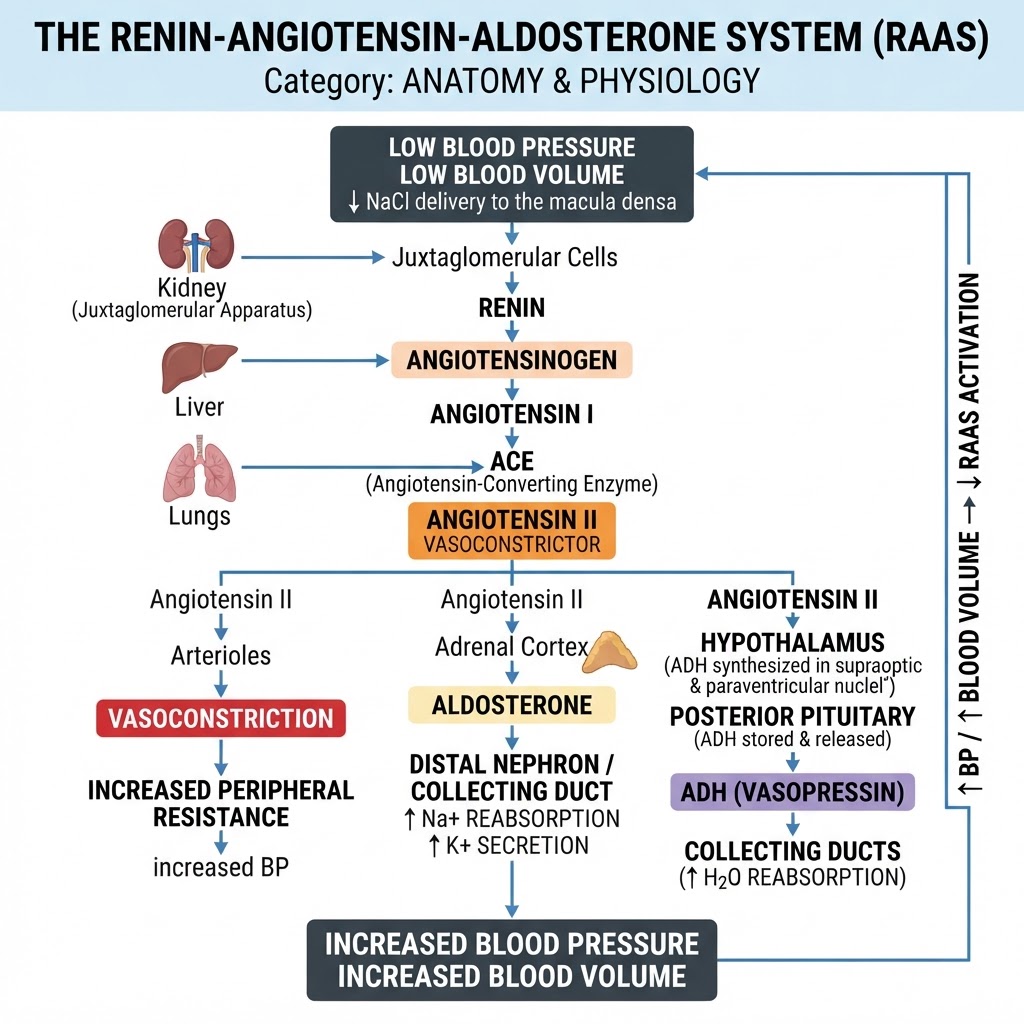
The RAAS is a hormone cascade that regulates blood pressure, extracellular fluid volume, and electrolyte balance. It is triggered by decreased renal perfusion and decreased NaCl delivery to the macula densa of the juxtaglomerular apparatus.
Activation Pathway
- Decreased renal perfusion and decreased NaCl delivery to the macula densa trigger the juxtaglomerular apparatus to release renin.
- The liver produces angiotensinogen, a distinct plasma substrate.
- Renin (from juxtaglomerular cells) acts on angiotensinogen to produce angiotensin I.
- ACE (angiotensin-converting enzyme, abundant in pulmonary endothelium) converts angiotensin I to angiotensin II.
- Angiotensin II has multiple downstream effects rather than a single linear chain.
Effects of Angiotensin II (three branches)
- Vasoconstriction of arterioles -> increased peripheral resistance -> increased blood pressure.
- Adrenal cortex (zona glomerulosa) -> aldosterone -> distal nephron/collecting duct: ↑ Na+ reabsorption and ↑ K+ secretion (water follows Na+).
- Hypothalamus: ADH is synthesized in the supraoptic & paraventricular nuclei, then transported down axons to the posterior pituitary, where it is stored and released -> ADH (vasopressin) acts on the collecting ducts -> ↑ H2O reabsorption.
- Net result: increased blood volume and blood pressure; targeted by ACE inhibitors and ARBs.
Like what you see?
Subscribe to unlock all 360 Study Cards and 15,000+ flashcards, track your progress, and study anywhere.